Summary
- ChatGPT Ads (also known as OpenAI Ads) have been available in the Netherlands since August 31, 2026. These are sponsored placements displayed below ChatGPT responses.
- Ads are only shown to eligible Free and Go users aged 18 and older.
- There are two advertising formats: standard ads for service providers and product ads using a product feed for online stores.
- Targeting uses context hints based on conversational context and intent, rather than keywords. Location targeting is currently limited to the country level.
- The minimum ad spend is €15 per day, and advertisers pay per click (CPC) or per thousand impressions (CPM).
What are ChatGPT Ads?
ChatGPT Ads are paid advertisements that can appear below a ChatGPT response. They are clearly labelled as sponsored placements and are visually separated from the response itself. This advertising channel connects with conversations in which people are researching options, comparing solutions or preparing to make a decision. For example, someone looking for software for a growing business, choosing a training course or trying to determine which product best suits their needs.
Advertisers cannot pay to influence ChatGPT’s responses. The advertising systems operate independently from the model that generates answers. A paid placement is therefore not an endorsement by OpenAI.
Who can see ChatGPT Ads?
ChatGPT Ads are available in the Netherlands, but they only reach a portion of ChatGPT users. Advertisements may appear to eligible adult users with a Free or Go account. Accounts identified by OpenAI as belonging to minors will not see advertisements.
Plus, Pro, Business, Enterprise and Edu subscriptions remain ad-free. Advertisements also do not appear in temporary chats.
This distinction matters when choosing your advertising channels. A large overall ChatGPT user base does not mean all those users can be reached through advertising. If your target audience primarily uses business subscriptions or other ad-free plans, your potential reach may be more limited than expected.
How do ChatGPT Ads work?
A separate advertising system evaluates which advertisements are relevant to a conversation. It considers factors such as the user’s needs expressed in the conversation, the advertisement itself, the landing page and the advertiser’s bid.
When multiple advertisements are eligible, OpenAI uses a relevance-weighted second-price auction. Your bid matters, but the highest bidder does not automatically win. The relevance of your offer to the conversation also plays an important role.
What types of ads can you create?
Currently, there are two advertising formats available: standard ads (left) and product ads (right).
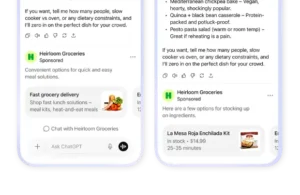
A standard advertisement includes elements such as your company name, logo, headline, description, image and a link to your website. This format can be suitable for service providers, software companies and training providers.
Product ads are generated using a product feed. This feed contains information such as product titles, images, prices and availability. For online stores, this makes it possible to advertise multiple products and automatically update product information.
How does targeting work with ChatGPT Ads?
Targeting in ChatGPT Ads primarily focuses on the context and intent of a conversation. Advertisers use context hints to describe situations in which their products or services may be relevant.
What are context hints?
For standard advertisements, you can add context hints at the ad group level. These describe your offering, the customer’s needs or situations in which your product or service provides value. They are not keywords with an exact-match setting.
Examples of context hints include:
- Accounting software for online stores looking to combine online orders and in-store sales.
- A training course for marketers who want to manage Google Ads campaigns independently.
- Ergonomic office chairs for people setting up a home office.
Our tip: Start with the questions customers ask before making a purchase. Which solutions are they comparing? Which requirements influence their decision? What information do they need? Our tests showed that more specific context hints resulted in a lower CPC and a higher CTR.
Can you target local audiences?
You configure locations through the campaign settings. Available targeting options may vary by country and campaign type. Therefore, always check Ads Manager to see whether your desired region is available. At the time of writing, location targeting in the Netherlands was only available at the country level.
How are ChatGPT Ads costs calculated?
The cost of ChatGPT Ads depends on your selected campaign objective. Costs can vary significantly depending on your offering, target audience and competition in the market. The table below shows how advertising costs are charged for each campaign objective.
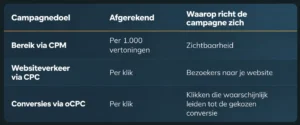
With oCPC, the system optimises towards actions such as purchases or enquiries. However, you still pay per valid click rather than per conversion.
How to launch ChatGPT Ads in seven steps
A ChatGPT Ads campaign consists of three levels within OpenAI Ads Manager: campaign, ad group and advertisement. If you have experience with Google Ads or Meta Ads, this structure will feel familiar.
- Determine whether ChatGPT advertising is suitable for your business. Research whether your target audience uses ChatGPT during relevant decision-making moments and whether your industry is permitted. Always check the latest advertising policies to ensure your advertisements comply with OpenAI’s requirements.
- Set up conversion tracking. Install the OpenAI Pixel or connect the Conversions API through GTM so you can measure leads and sales.
- Create your campaign. Choose your objective (reach, clicks or conversions), your budget (starting from €15), your target country, platforms (iOS, Android and web) and, if applicable, the conversion event you want to optimise for. You can also choose between a standard ad campaign and a product ad campaign.
- Connect your product feed (online stores only). Upload your feed as a CSV/TXT file or connect it through a hosted URL or SFTP. We recommend using a hosted URL or SFTP because prices and stock levels can then be updated automatically.
- Set up your ad groups. Create separate groups for different themes, needs or intentions. Add context hints, choose your bidding strategy and configure your destination URL and any tracking parameters. For product ads, select which products from your feed should be included.
- Create your advertisements. For a standard advertisement, enter a headline, description, image and landing page. Product advertisements are automatically populated using your product feed.
- Measure, learn and optimise. Compare your results with your Google Ads and Meta Ads campaigns and evaluate whether the channel provides additional value after the testing period.
ChatGPT Ads vs. Google Ads and Meta Ads
These three advertising channels reach people at different stages of their decision-making process and use different signals to determine which advertisements to display. Here is a simplified comparison:
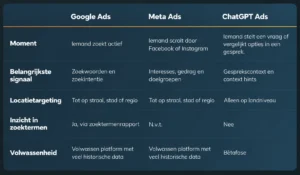
Google and Meta also offer multiple campaign types, such as Performance Max within Google Ads. This comparison is therefore a significant simplification.
Which businesses can benefit from ChatGPT Ads?
You can only spend your marketing budget once, so choosing the platform that delivers the best results is important. Whether ChatGPT Ads are suitable for your business depends on several factors. Below is a simplified overview.
Potentially a good fit
ChatGPT Ads may be interesting when:
- you are already getting strong results from SEA and social media advertising and want to expand your reach;
- customers research and compare different options before purchasing;
- your product or service requires some explanation;
- the purchasing decision is not impulsive;
- you can clearly communicate multiple applications or benefits;
- you can accurately track leads, enquiries or sales;
- you have sufficient margins and budget to experiment.
Examples include software, business tools, training courses, travel products, interior products, technical solutions and often higher-priced products where customers compare specifications or alternatives. These are examples, not guarantees of suitability or performance.
Probably less suitable
ChatGPT Ads may be less suitable when:
- you are not yet getting the most out of SEA and social media advertising;
- you have very little budget to test different advertising messages;
- you expect immediate and predictable returns;
- your product or service does not require research or comparison;
- your products are mainly purchased on impulse;
- your target audience primarily consists of people aged 45 and older;
- your target audience mainly uses paid or business ChatGPT subscriptions.
Not every industry is allowed
OpenAI excludes or heavily restricts several categories. These include political advertising, gambling, alcohol, tobacco and legal services. Financial and medical products and services are also prohibited in almost all cases. Always check the latest advertising policies before investing time and budget.
Should your business start using ChatGPT Ads?
The short answer: for most businesses, ChatGPT is not yet the advertising channel that delivers the best return on their advertising budget. For now, we see ChatGPT Ads as an addition to existing channels rather than an alternative.
Why we are still cautious
ChatGPT Ads are not yet comparable to established advertising platforms such as Google and Meta in terms of maturity. Google Ads is the most logical comparison because both channels reach people who are actively searching for information or preparing to make a decision. However, Google offers far more extensive targeting options, reporting capabilities, historical data and optimisation tools.
In addition, Google is increasingly integrating AI-generated answers into the search experience. With AI Max, existing search campaigns can identify broader and more complex search queries while aligning advertisements and landing pages with user intent.
ChatGPT Ads also currently lack a search terms report. You can see impressions, clicks, costs and conversions, but not which conversations triggered your advertisements. This makes it harder to explain performance and optimise campaigns effectively.
Finally, we have concerns about advertising volume in the Netherlands, particularly for niche products and services. After all, advertisements are only displayed to eligible Free and Go users.
When might a pilot campaign be worthwhile?
For businesses already achieving strong results with Google and Meta and having additional budget available, testing ChatGPT Ads may be worthwhile. During the early stages, you can gain experience before the platform becomes more competitive. Businesses with strong Generative Engine Optimisation (GEO) may benefit in particular, as they are more likely to appear organically in conversations.
The relevance between the conversation and the advertisement is especially important. Imagine someone asking ChatGPT to compare power drills, with model X emerging as the best option. An advertisement for model X may reinforce the user’s confidence. However, if an advertisement for model Y appears, despite that model performing poorly in the comparison, it could have the opposite effect.
Our recommendation: For now, treat ChatGPT Ads as a controlled experiment rather than a replacement for proven Google Ads or Meta Ads campaigns. Before launching, determine:
- whether your target audience uses ChatGPT during relevant decision-making moments;
- whether your offering aligns with the context of those conversations;
- whether a pilot campaign can deliver measurable additional value alongside Google and Meta.
Over de auteur